Showing posts with label electricity offsetting. Show all posts

Thursday, December 3, 2015

Reducing Electricity Costs With Net Metered Solar Power

So how and what can you hope to save by installing solar power onto the roof of your home?

There has been and in some cases still is, a large misconception out there by some Aussie householders in various communities, that the only way to save is via the 6 to 8 cent rebate.

There are some homes in Sydney that we know of, where the size of the solar system is to great and thus the payback time far longer.

Well a net metered solar pv system can help you save off electricity costs by:

  • Generating your own power and using it during the sunny hours of the day, in real-time. This reduces your electricity bill by the amount you would have normally have purchased for the same period.  For example a 2kW system will have produced around 8kW [Annual daily average]. This is worth $2.40 per day if you are on a 30 cent tariff. This equates to $840 per year or $210 off the quarterly electricity bill
  • Sending any excess power not used during the daytime, back into the grid. Where you get a rebate of 6 or 8 cents per kW. Technically reducing a 30 cent tariff to 24 / 22 cents.

If it was the case of solar power not being profitable under the net metered system, then we would not see solar power systems still being installed in many streets around Australia.

It is only the solar power savvy householders whom really save off the electricity bill. These householders understanding 100% how the net metered solar power system works and making the move if it is suited, to install it into their home.

It may be the media has led some of you astray, by reporting that solar power in Australia is dead since the end of the gross metered system. But that is not the case as some homes can save dramatically off the electricity bill, with a net metered solar system.

It really comes down to the amount of power you are using on a daily basis during the sunny hours of the day. As this is the power your solar power system is going to be providing you with, saving you what you would normally being paying for.

Further more by directly offsetting electricity costs, you save more as the cost of the electricity rises! Now this surely has to be a great idea!

A 3kW solar system in Sydney could easily generate up to $7000 of free electricity from the sun when offsetting electricity at 30 cents per kWh.

So what are you waiting for? Why not call Aussie Home Energy for more help and at least check out what we have to offer on the subject of SOLAR POWER NET METERING.

This blog post brought to you by Aussie Home Energy, a major player in the HOME ELECTRICITY SAVING SERVICE industry in Australia.

Wednesday, August 20, 2014

How To Make Solar Power A Successful Investment

Making Solar PV Successful
No one would argue that by installing solar power on the roof of your home, you are going to save off electricity costs.

It's not always the gross or net 'feed in tariff', that's reducing the home's electricity costs though. How much you save and how quickly, all depends on the correct matching and sizing of the solar system to your needs. 


Especially important when you are connecting to the grid via a NET meter, which is common now across a lot of parts of Australia.

Any home or small business around Australia can now directly offset the electricity used during the 'sunny hours' of the day. This offsetting of electricity is separate to any form of gross or net feed gain. It simply relies on you knowing what you use under the roof and what is using the power when the sun is shining.

The simple system of electricity offsetting seems to have been forgotten, or was not fully understood by many Aussie householders we visit during our ELECTRICITY AUDITING SERVICES. It is not uncommon to hear a householder complaining their solar system is not making money, especially when they are ONLY looking at the power exported, for a small six or eight cent return. This of course is a miss-understanding by the householder and should have been fully understood during the time of sale, yet it is not. Shocking is the fact it has often in the past not been explained by the sales person either.

Currently in NSW offsetting home electricity costs during the 'sunny hours, can mean a possible $641 per year off the electricity bill by installing a small 1.5kW solar power system! With a 3kW system generating a possible staggering $7000 of electricity above the roof over five years, based on a 5% increase per year on a 30 cent tariff.

Now that is something that needs to be understood you would think by every householder looking to save big time on electricity costs. And how long is the expected life of the solar system? Well we can say on average around twenty-five years. So that is a lot of free electricity from the sun, is it not? And as electricity prices rise so do those electricity savings!

It's a fact also that by offsetting your home electricity during the daytime, you can even save more $$$ off the electricity bill, compared to the recent NSW Government's 20 cent gross feed system!

You just need to understand the maths and be using the power under the roof in those sunny hours of the day to maximise your solar investment. To learn more about making solar power into a successful investment visit our NET FIT METERING & BILLING.


Sep 2015 : See our addition to this post, where we discuss a great SOLAR PV MONITORING ANDROID APP suitable for all net metering environments.

This blog post brought to you by Aussie Home Energy, a major player in the HOME ELECTRICITY REDUCTION SERVICE industry in Australia.

Tuesday, August 5, 2014

Correct Measurement Of Import / Export Using Ausgrid's TOU Meters


http://aussiehomeenergy.com.au/html/solar_pv_meters.html
Metering Makes BIG Differences In ROI
We are happy to see Ausgrid's online metering information now removes any ambiguity regarding the best import / export electricity meter, for correct / beneficial output towards the end user.

Ausgrid's report states the following,

Where net metering is installed to record bi-directional energy, the metering equipment used by Ausgrid registers the addition of the instantaneous power flows in each phase.


In three phase installations this is particularly important where a single phase embedded generation system is installed.

The following example illustrates how the meter will record energy.

If the following, unity power factor current is flowing through the meter,


  • A Phase 8 Amps consumption (1.84kW @ 230V AC)
  • B Phase 12 Amps consumption (2.76kW @ 230V AC)
  • C Phase 7 Amps generation (1.61kW @ 230V AC)

The resultant power flow registered by the meter would be,


+1.84kW + 2.76kW – 1.61kW = +3.0kW towards the premise.
 

The above statement should now help anyone whom is thinking of installing solar, from falling into some of the past traps,


  • Incorrect metering installed resulting in reduced electricity offsetting
  • Incorrect metering installed resulting in increased exporting of power
  • Being sold a larger three phase inverter because the home is three phase, when a single phase matched to sunny hour usage would have done the job, with the correct poly-phase meter installed

Visit our Solar Power pages to see more of Ausgrid's statement and also learn more about NET FIT METERING & BILLING and the TYPES OF NET METER. Knowledge that will certainly help you maximise your solar investment.


This blog post brought to you by Aussie Home Energy, a major player in the HOME ELECTRICITY SAVING SERVICES industry in Australia.

Monday, December 16, 2013

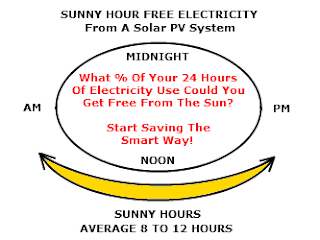
What Is Your Sunny Hour Electricity Use?

What Is Your Sunny Hour Electricity Usage?
What Could You Be Saving?
When this question is asked to householders looking for savings on the electricity bill, most do not have a clue. Amazing as this sunny hour electricity use, can be offset by simply installing a solar power system.

Meaning you make your own power, that is simply used by your appliances, during the sunny hours of the day. 

Once you know the usage, you also know the electricity savings you will reap by installing a solar system. Now we are talking here about a solar system connected to the electricity supply via net metering.

This is where the power is for use firstly by the home. If not used then it goes back into the grid for maybe a small feed in tariff. So the winners here, are those homes that use six or more kilowatts of electricity during the sunny hours of the day.

Let us say you use around twelve kilowatts of power during these sunny hours. And that same power is costing you thirty-five cents per unit. Well our maths shows us that is four dollars and twenty cents per day, every day. and this is a cost you could be saving, off the electricity bill. 

As you can see there are excellent possible electricity bill savings to be made!

What needs to be discussed in further detail, is when you are using this power and the size of the loads in question, thus getting a more accurate idea of the true saving. All of these facts are easily discovered when a SOLAR POWER ASSESSMENT of your home is undertaken.

Now if you do not want a Solar Power Assessment you could work this out for yourself by simply reading your electricity meter, at the time the sun hits your roof and leaves your roof.

Another option is to install an ELECTRICITY MONITORING DEVICE where of course you will be able to learn far more, about electricity in your home other than the sunny hour usage.

So what are you waiting for? Solar Power is one of the best ways to save on electricity costs. Not in all cases, but where there is high sunny hour usage, it is sure a great winner!

This blog post and podcast brought to you by Aussie Home Energy, a major player in the HOME ELECTRICITY REDUCTION SERVICE industry in Australia.

Monday, August 13, 2012

Sizing A Solar PV System To Accurately Offset Electricity Usage

Sizing a Solar PV System accurately for the purpose of electricity offsetting, is not easy. Whilst there may be a few guessing techniques used by some solar providers, to work out how much power your household is using during the day, a simple accurate solution is to install a HOME ELECTRICITY MONITOR.

In a situation where there is no Gross FIT & the Net FIT is only a few cents return per kW generated, most householders are under the belief that a solar system on the roof, has little benefit. Could this be due to many of the negative media articles? What if you are not aware, by installing a solar system you could be saving big dollars off your electricity bill? So how do you workout what size solar pv system you need, and what are those forecast electricity savings?

Firstly you need to think about the idea of installing a home electricity monitor in your home. A monitor that is not just going to show you how much power your using in the day, when the sun is shining. But a monitor that supplies information, allowing you to cut electricity usage and costs, even before your solar pv system is installed. And you will not be generating power to support waste underneath the roof, as too many households are!

A monitor further makes sure your new solar pv system, is tailored accurately to your home's electricity usage. As offsetting the power you would normally purchase, is where you are going to make money. You will be maximising electricity savings only, whilst not pumping excess electricity back into the grid, where there is little or NO RETURN! This same monitor can further report on the generated power of your solar system and instantly report to notify you of any problems with generated solar output.

To learn more about how you go about tailoring your new solar pv system, to maximise electricity usage reduction and costs, you need to visit Aussie Home Energy's webpage on OFFSETTING YOUR ELECTRICITY COSTS, with a Solar PV System. Where you will find all the information you need to know.

Alternative Uses For 50W Of 24/7 Wasted Standby Power?

Powered byEMF Web Form